
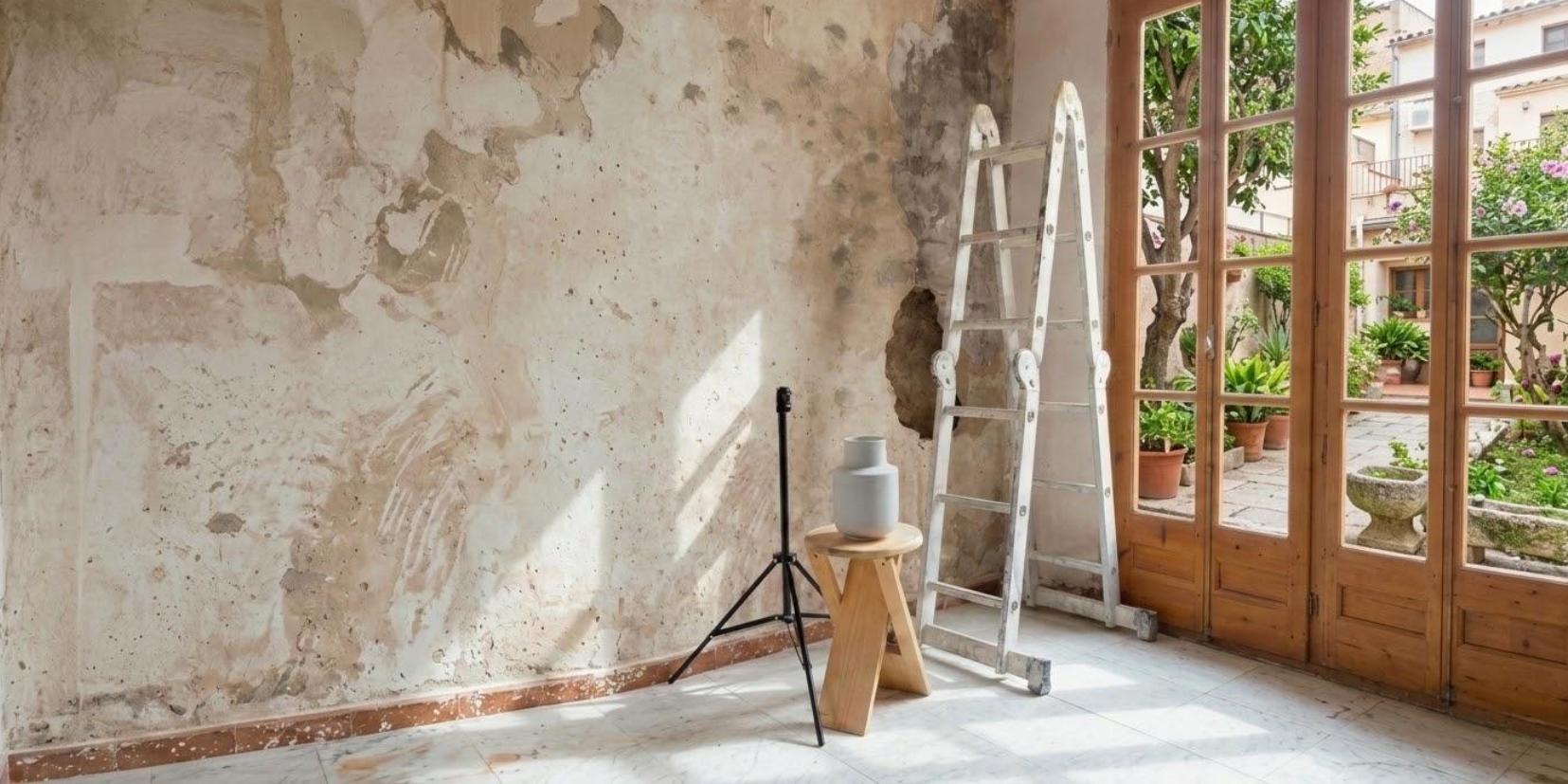
Anti-damp Ground Floor Renovation in Barcelona
A Barcelona Architect’s Guide to Anti-Damp Solutions
Barcelona concentrates almost 40% of its annual rainfall between September and November.
If you live in a street-level ground floor in neighborhoods like Gràcia, Horta, Sarrià-Sant Gervasi, Poblenou, or Vallvidrera, you will know exactly what we are talking about. The city’s street names themselves do not lie: the presence of more than twenty streets containing the words Torrent or Riera reminds us that water naturally seeks its old path towards the sea.
In older buildings — especially those built before 1980 without insulated foundations or a ventilated crawl space — groundwater rises and ambient humidity condenses into water droplets inside homes. This is not just an aesthetic issue or an inconvenience of bad odor: it is a real health risk for its occupants. Continuous exposure to damp spaces promotes the appearance of mold spores, dust mites, and bacteria that directly affect lungs and respiratory tracts. Young children and the elderly are particularly vulnerable, potentially developing lifelong chronic conditions such as asthma.
Protecting your home against autumn humidity requires applying certain long-term actions, but you can also use easy resources for this year. Below, we thoroughly analyze the 4 key strategies to adapt a ground floor in Barcelona, breaking down the definitive option with renovation and the temporary option without renovation to apply this season. I also include their pros and cons, approximate prices for 2026, future energy regulations, and concrete steps you can take today. This content has been features in the Spanish newspaper La Vanguardia. Read it from there too here: Soluciones contra la humedad
Before I share that magic list of four strategies you can implement, let me introduce myself in case we haven’t met yet: I am Esther Rovira (ERA architects), an architect and passive house designer based in Barcelona and Catalonia, specializing in unique passive houses and full, turnkey sustainable renovations. In this article—”Anti-damp Ground Floor Renovation in Barcelona“—you will find these five key points clearly explained:
- Strategy 1: With and WITHOUT renovation
- Strategy 2: With and WITHOUT renovation
- Strategy 3: With and WITHOUT renovation
- Strategy 4: With and WITHOUT renovation
- The legal framework and how it affects you
- Conclusions
- Your next step
So let’s dig into it!
Strategy 1: Insulate the floor (Stopping cold and rising damp)
The floor of a ground-level apartment directly on an uninsulated slab acts as a constant thermal bridge. In autumn and winter, the cold floor comes into contact with warm indoor air, causing condensation humidity on the surface.
Option A: Full Renovation (Insulating foam and insulated slab)
If you are immersed in a complete renovation, do not skimp on the base. The ideal approach consists of adding at least 5 cm to 8 cm of extruded polystyrene (XPS) panels under the final flooring (parquet, microcement, or stoneware).
- Pros:
-
- Permanently eliminates the cold entering from the subsoil.
- Drastically improves the home’s energy efficiency, reducing heating bills by up to 15-20%.
- Definitive solution for the entire lifespan of the property.
- Cons:
-
- Requires losing height (between 8 and 12 cm) or excavating (with its corresponding demolition and debris removal).
- High initial financial investment.
- Estimated cost in 2026: Between €65 and €110 per m² (includes demolition, 50mm XPS insulation, concrete slab layer, and medium-grade flooring).
Option B: Without Renovation (Technical textiles and natural wool rugs)
If you are not carrying out work this year, the temporary strategy consists of placing textile thermal barriers in areas where you spend the most hours. Use thick, high-grammage natural wool rugs under the bed or in the desk area if you work from home. You can place a plastic sheet under the rug to protect it, but you will need to mop up the water that condenses under the sheet.
- Pros:
-
- Immediate setup without dust or building permits.
- Warm feeling to the touch.
- Economical and reusable if you move (perfect if renting).
- Cons:
-
- Does not eliminate subsoil dampness; it only delays heat transfer.
- Requires rigorous maintenance: if the rug absorbs ambient humidity without airing out, dust mites can accumulate. It is essential to wipe away water under the sheet and air out the room daily.
- Estimated cost in 2026: Between €150 and €450 per large format rug (200×300 cm) in 100% natural wool.
Strategy 2: Inject moisture blockers (Chemical barrier against rising damp)
Rising damp occurs when groundwater rises through the porous material of walls (brick, concrete, or stone). This process dissolves salts that end up destroying paint, which is precisely what is seen on ground-floor walls: swollen or peeling paint.
Recommended Option: Hydrophobic resin injections (With and WITHOUT renovation)
Fortunately, this treatment does not require tearing down walls and can be applied in both renovations and inhabited homes. It consists of drilling a series of holes low down at the base of the wall (every 10-12 cm) to inject silane- and siloxane-based gels. These compounds expand through the pores of the brick and mortar, crystallizing and creating a continuous horizontal barrier that prevents moisture from rising further.
- Pros:
-
- Can be applied quickly in 1 or 2 days without having to leave the home.
- Very high effectiveness proven in typical brick walls of Eixample, Gràcia, and Ciutat Vella.
- Manufacturer and installer warranty that usually ranges between 10-20 years.
- Cons:
-
- Requires a drying period for the wall that can last several months before repainting the damaged surface.
- If walls are made of thick, heterogeneous natural stone (old load-bearing walls over 50 cm thick), injection requires a more complex preliminary technical study.
- Estimated cost in 2026: Between €110 and €180 per linear meter of treated wall (varies according to wall thickness).
Strategy 3: Insulate walls of courtyards and communal entrances (Lateral dampness)
The vast majority of ground-floor homes in Barcelona adjoin communal hallways, damp lightwells, or adjacent land at different heights. In these cases, dampness enters laterally.
Option A: Full Renovation (Self-supporting wall lining with water-repellent insulation)
The professional solution is to build a false interior wall (water-resistant plasterboard lining), filling the cavity with mineral wool or rock wool. Key point: in the first 50 cm in direct contact with the floor, the insulation must be waterproof, such as extruded polystyrene (XPS).
- Pros:
-
- Complete elimination of cold walls and surface condensation.
- Allows hiding electrical and plumbing installations.
- Extra acoustic insulation against neighborhood or street noise.
- Cons:
-
- Reduces the room size by about 7 cm per wall.
- Requires complete dry construction, jointing, and painting.
- Estimated cost in 2026: Between €55 and €90 per m² of wall (including frame, water-repellent insulation, and finish).
Option B: Without Renovation (Breathable paints and decorative panels)
To get by without work this autumn, there are two main alternatives:
- Lime-based or anti-condensation paints: Natural lime paints are alkaline and breathable, preventing mold growth naturally. Anti-condensation paints incorporate glass microspheres that slightly break the thermal bridge.
- Cork or wood panels: Applied to strategic walls (such as behind the bed headboard), they act as temporary thermal and moisture regulators.
- Pros:
-
- Low cost and possibility of execution by the user (DIY).
- Aesthetic improvement of worn-out rooms.
- Cons:
-
- Strictly temporary solution. If lateral dampness is severe, cork or wood will eventually warp or detach after a single very humid winter.
- Paint does not solve the underlying issue; it only slows visible deterioration in the short term.
- Estimated cost in 2026:
-
- Anti-condensation/lime paint: €12 to €25 per liter (material cost).
- Decorative cork/wood panels: €30 to €70 per m².
Strategy 4: Ventilation (The most critical and underrated factor)
Even if you insulate the floor and walls, a human at rest constantly exhales water vapor. Added to this are showers, cooking, and drying clothes indoors. If the dwelling lacks adequate ventilation, the air becomes saturated, and moisture deposits on the coldest areas of the property.
Option A: Full Renovation (Mechanical Ventilation with Heat Recovery – MVHR)
This is the crown jewel of modern sustainable building and an essential recommendation in any comprehensive renovation project. A dual-flow MVHR system continuously extracts stale air from bathrooms and kitchens while supplying fresh, filtered air from the street into living rooms and bedrooms.
In addition, you can incorporate a heat recovery unit. The outgoing stale air tempers the incoming fresh air without mixing, reducing heating needs in winter (in summer, a bypass is used to avoid this process and keep things cool).
- Pros:
-
- Guarantees total air renewal in the home every 2-3 hours, 24 hours a day.
- Filters pollen, city pollution (PM2.5), and mold spores before they enter the home.
- Massive energy savings: recovers up to 80-90% of indoor heat, drastically reducing heating usage.
- Avoids having to open windows in the middle of winter and lose heat.
- Cons:
-
- Requires installation of distribution ducts through false ceilings throughout the house.
- Significant initial investment.
- Estimated cost in 2026: Between €4,500 and €8,500 (for a home of about 70-90 m²; includes centralized unit, ductwork, vents, and technical installation).
Option B: Without Renovation (Manual cross ventilation and dehumidifiers)
If you do not have an automated system, you must resort to strategic manual ventilation: open windows on opposite facades to generate air drafts (cross ventilation) for at least 45 to 60 minutes a day, preferably split into two sessions (morning and evening). If the apartment is internal or lacks opposite windows, use fans in windowless rooms directed toward the doorway to force air circulation.
As support, using portable electric dehumidifiers (compressor or desiccant types) is practically mandatory in Barcelona ground-floor apartments during autumn months.
- Pros:
-
- Zero installation cost.
- Immediate air quality improvement and instant reduction of foul odors.
- Cons:
-
- Considerable heat loss in winter, increasing heating expenditure.
- Relies on daily user habits and discipline.
- Estimated cost in 2026:
-
- Manual ventilation: €0.
- Quality portable dehumidifier (20L/24h): €180 to €320 (plus an estimated electricity cost of €0.15 – €0.35 per hour of use).
The legal framework: The European directive and the 2033 horizon
Beyond immediate comfort and health, there is a strong legal reason to take ground floor insulation seriously. The European Energy Performance of Buildings Directive (EPBD) requires progressively reducing energy consumption in homes and buildings across Europe.
By 2033, residential buildings in Spain must achieve a minimum energy efficiency rating of D (with the ultimate goal of zero emissions by 2050).
How will this affect ground-floor property owners in Barcelona?
Although exact regulations are formulated through royal decrees and regional laws, industry experts agree that a minimum energy rating could become an essential requirement for renting or selling a property, in the same way that presenting an Energy Performance Certificate (EPC) or Habitability Certificate is mandatory today.
An uninsulated ground floor in Barcelona with severe moisture issues and thermal leaks through the floor typically falls into ratings F or G. Failing to adapt these homes in the medium term means the impossibility of legally marketing them in the future real estate market or suffering severe devaluation.
Decision comparison table: With or Without Renovation?
| Strategy | WITHOUT Renovation (Temporary & Immediate) | Cost WITHOUT renovation 2026 | WITH Renovation (Definitve) | Cost WITH renovation 2026 |
| Floor | Natural wool rugs + daily ventilation | €150 – €450 | Slab with 5-8cm XPS insulation | €65 – €110 / m² |
| Walls | Silane/siloxane chemical injection | €110 – €180 / l.m. | Chemical injection + technical drying | €110 – €180 / l.m. |
| Partition Walls | Lime/anti-condensation paint or cork | €20 – €70 / m² | Self-supporting wall lining with XPS/Wool | €55 – €90 / m² |
| Ventilation | Cross ventilation (1h/day) + Dehumidifier | €180 – €320 | Dual-flow MVHR with heat recovery | €4,500 – €8,500 |
Conclusions
- Moisture is a structural and health problem, not just aesthetic: Living in an uninsulated ground floor in certain Barcelona neighborhoods during autumn exposes the family to serious respiratory issues.
- There are temporary solutions for every budget: You do not need to face a full renovation this month to protect yourself from moisture. Simple actions like hydrophobic injections, disciplined ventilation, and mechanical dehumidification can reduce the problem by 30-40%.
- Temporary fixes have an expiration date: Non-renovation solutions (cork, rugs, paints) improve comfort, but subsoil dampness remains. Planning a sustainable renovation in the medium to long term is essential for your health and real estate investment.
- Property value is at stake: With the arrival of the 2033 European directive, properly insulating your ground floor is not only an investment in personal well-being, but also a way to protect your property’s market value.
Your Next Step: Action plan for this autumn
If you want to prepare your home today before heavy rains start in Barcelona, follow this action sequence:
- Step 1 (Today): Perform a quick visual diagnosis. Inspect the bottom 30 cm of the apartment’s walls. Is there peeling paint, black mold, or white salt efflorescence? If yes, identify critical walls bordering the street or land.
- Step 2 (This week): Get basic ventilation/dehumidification equipment. Acquire a portable dehumidifier suitable for your home’s square footage and establish a routine of cross ventilation for 30 minutes in the morning and 30 minutes in the afternoon.
- Step 3 (This month): Request a professional evaluation without obligation. Contact a moisture specialist technician or a local architecture firm familiar with Catalan regulations in your city. Request a quote for silane injection in perimeter walls (the most cost-effective solution without major work).
- Step 4 (Future vision): Prepare your 2033 energy plan. If you plan to renovate your home in the next 2 to 5 years, make sure to ask your architecture team for a project including an insulated slab and a dual-flow mechanical ventilation system with heat recovery. Your health and wallet will thank you.
I hope this post, “Anti-damp Ground Floor Renovation in Barcelona” helps you get your home ready to start the season off on the right foot.
If your situation requires a full, major renovation to prepare your home sustainably for new European Union regulations, I recommend hiring an expert and planning your next steps based on your budget.
If you are ready to go, book now your online meeting so we can start heping you this week: BOOK a call.
Not ready yet? No problem, check our our other posts below that might keep helping you without contacting us directly.
Did we miss anything? Any burning questions? Leave them in the comments and we’ll be happy to help.
See you on the next post,

P.S. Wanna get FREE tips for your project weekly? Yas! or follow us on Instagram and Facebook

Leave A Comment